Nonlinear Dynamics
简体中文 · Previous: Screening Study · Next: Orbit correction
Nonlinear Dynamics is a durable exact-lattice, finite-turn, fixed-δ 4D DA/FMA screening workspace for v0.2 projects. Engine v0.8 remains the physics authority; Studio stores a revision-bound study draft, manages the job, and visualizes strict evidence.
On first entry, Studio also loads a frozen bundled acceptance fixture so DA/FMA, loss, and convergence views can be inspected offline. Evidence origin identifies it as acceptance/validation; it cannot be promoted into a formal current-project result. Only a durable project runtime result enters the independent formal store.
Configure the study
Open Calculate → Nonlinear Dynamics → Setup:
| Input | Choice/default |
|---|---|
| Observation occurrence | Stable occurrence in the current lattice |
| Location | Entrance, Center, or Exit |
| Explicit δ list | -0.01, 0, 0.01; Engine limit is 7 |
| Convergence profile | Fixed v0.8, 512/1024/2048 turns |
| Aperture source | Read-only completeness and physical-loss permission |
Radiation, quantum excitation, collective effects, RF kick, magnet errors, and orbit correction are fixed OFF. They cannot be enabled in this accepted v0.8 route.
Saving .vmaproj saves the study draft. A project/content/physics edit marks it
STALE REVISION and requires review before a new run.
Run and recover
Select an exactly compatible v0.8 target. Run durable nonlinear v0.8 becomes available only after protocol, source, CPU durability/reconnect, limits, and profile all agree.
- Detach: stop observing, without cancelling remote work.
- Reconnect: continue from the retained job/token.
- Cancel remote job: cooperative cancellation.
- Retained formal results → Reopen: offline reopening with full verification.
The current exact source requirement is
5253d6758042381bab15ed9c385aef78bd0331f6. A different or later build does not automatically
pass.
Result tabs
- Dynamic Aperture: first-quadrant boundaries by δ, overlay, zoom, PNG/SVG.
- Tune Footprint / FMA: filter
Qx–Qypoints by δ, amplitude, angle, and resonance order; hollow points are unqualified. - Losses: filter causes and inspect lattice
s, turn distribution, and occurrence. - Convergence: independent turn, radial, angular, and slicing adjacent-level gates.
- Evidence: project/revision, coordinates, Engine, projection, qualification, hashes, plus CSV and canonical JSON export.
- Setup: draft, runtime, and retained results.
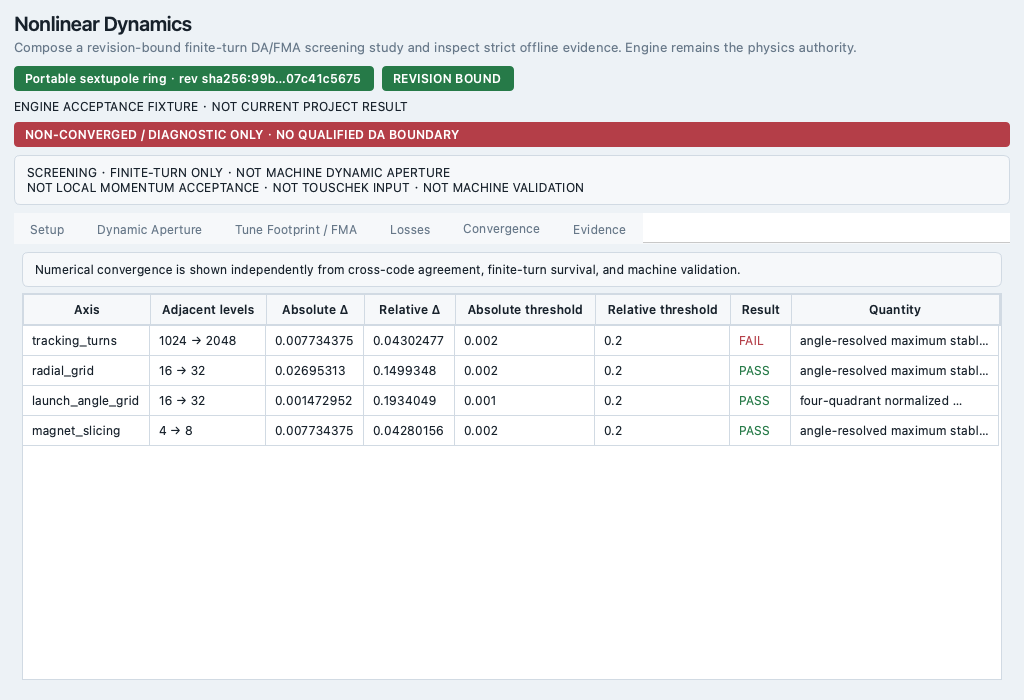
When numerical convergence or independent evidence fails, diagnostic points remain visible but
the page states NO QUALIFIED DA BOUNDARY and suppresses qualified-boundary plot/export.
Hands-on example
Open
protocol/nonlinear_lattice_projection_v0_1/fixtures/portable-sextupole-ring.studio-project.json,
choose Entrance and -0.01, 0, 0.01, select the v0.8/5253 target, and wait for the runtime gate.
Run, record the ndj8-* ID, detach once, reconnect, and wait for three artifacts. Review
Convergence before DA/FMA, then export a plot and CSV.
Interpretation boundary
This is ideal-lattice CPU finite-turn screening. Finite-turn survival is not infinite-time stability. DA is not LMA and cannot feed Touschek. Incomplete aperture cannot support a complete physical-loss claim. PyAT agreement is numerical cross-code evidence, not machine validation. There is no RF/radiation tracking, quantum excitation, collective effect, error/correction, strong coupling, GPU, or SLURM execution.